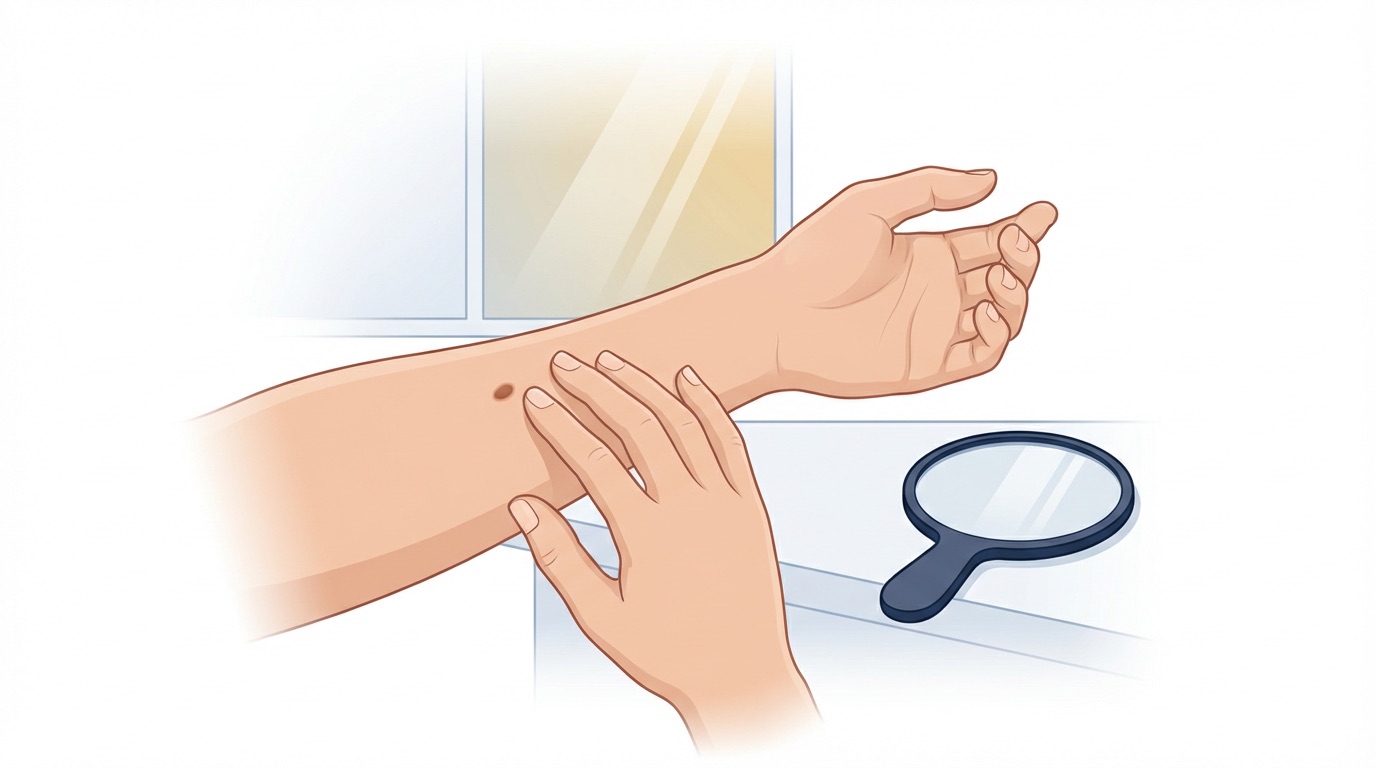
"I've been watching this mole for months — am I being ridiculous?" It is probably the single most common opening line in my skin clinic, and my answer is always the same: no, you are not being ridiculous. Paying attention to your skin is sensible, and the patients who catch things early almost always do so because they were paying attention.
Anxiety about moles is common and entirely valid. The purpose of this guide is to help you separate the changes that are normal and expected from the ones that deserve a professional look — and to explain what happens when you come to a specialist.
What normal mole changes look like
Moles are not static. They have a natural life cycle, and some of the ways they change are entirely benign.
- New moles in childhood and adolescence: most people develop the majority of their moles by their mid-twenties. Slight growth during puberty is normal.
- Hormonal change in pregnancy: moles can darken a little during pregnancy. This is recognised, not pathological, but any mole that changes in other ways during pregnancy should still be assessed.
- Fading with age: many moles become paler or flatter from the fifties onwards, and some disappear altogether.
- Seborrhoeic keratoses: these are not moles at all, but warty, "stuck-on" brown growths that appear from middle age onwards. They look concerning to patients but are entirely benign.
What concerning changes look like
The features below, particularly when several appear together, raise the threshold for professional review:
- Rapid growth over weeks or a few months.
- Colour change — darkening, loss of pigment, new shades within one mole.
- Irregular shape or edge — asymmetry, notched or blurred borders.
- Bleeding from a mole without obvious trauma.
- Persistent itch or tenderness.
- Ulceration or crusting that does not settle.
- A new mole appearing after the age of 40, especially if it looks different from your other moles.
The ABCDE rule — a quick summary
The ABCDE rule is a widely used framework for assessing pigmented lesions. It is not a substitute for specialist examination but is genuinely useful for self-monitoring.
- A — Asymmetry
- B — Border irregularity
- C — Colour variation
- D — Diameter (larger than 6 mm)
- E — Evolving (the single most important letter)
For a fuller explanation, see our detailed page on the ABCDE rule or our blog article on the early signs of skin cancer.
The "ugly duckling" sign
Most of us have our own pattern of moles — they tend to look like siblings, with a shared family resemblance in size, colour and shape. Melanomas often break that pattern. If one mole clearly stands out as different from the rest — darker, larger, oddly shaped — it is the "ugly duckling". This single observation has been shown to improve the detection of early melanoma even by non-specialists, and it is worth taking seriously when you spot it.
"If a mole looks out of place among your others, trust your instinct. The brain is astonishingly good at pattern recognition, and the ugly duckling sign frequently beats the ABCDE rule in real-world self-examination."
GP (General Practitioner) first, or specialist direct?
Both are reasonable routes. Your GP can assess most moles and, through the NHS two-week-wait pathway, refer suspicious lesions urgently for specialist review. If you prefer to move directly to a specialist — for speed, continuity or reassurance — a private skin cancer consultation provides rapid access to dermoscopy, biopsy and, if needed, treatment under one clinician. We cover this in detail in our article on what to expect from a private skin cancer consultation.
What a specialist skin check actually involves
A specialist mole check is not just a look. A typical appointment lasts around 15 to 20 minutes and includes:
- History: personal and family skin cancer history, your own skin type, any lesion you are particularly concerned about.
- Full skin examination: from scalp to soles, including the scalp, behind the ears, between the toes and the nails. This is not compulsory — you are welcome to ask for only a focused check — but a full examination is what I recommend.
- Dermoscopy: a handheld magnified, polarised device that reveals microscopic structures in pigmented lesions and allows far more confident diagnosis than the naked eye.
- Photography where useful, so changes can be compared over time.
- A clear plan: reassurance and discharge, re-review in a set period, or same-day biopsy under local anaesthetic.
To book an assessment, use the mole check booking page or visit the Skin Cancer Centre.
A final word of reassurance
The vast majority of moles that patients worry about turn out to be entirely benign. An appointment is not a commitment to something scary — it is usually a fast route to peace of mind, and often it is simply reassurance and a handshake. If you are in any doubt, please do not sit with that doubt for months. A short conversation with a specialist is a kind thing to do for yourself.