There is a moment, familiar to almost every skin cancer specialist, that arrives in the weeks after the summer holidays. The suitcase is unpacked, the tan has begun to fade, and — stepping out of the shower or scrolling through beach photographs — you notice a mole you do not remember. Perhaps it looks darker than you recall, or perhaps you cannot remember it being there at all. Every August and September, clinics see a rise in exactly this concern — and in the great majority of cases, the answer is entirely reassuring.
Why late summer is when we notice our skin
The seasonal pattern has a simple explanation. For much of the year, British weather keeps most of our skin covered, and few of us routinely inspect our own backs, shoulders or legs. On holiday, all of that changes: more skin is on show, we see ourselves in swimwear and in brightly lit hotel mirrors, and holiday photographs capture angles we never normally view. Then, as a tan fades unevenly over the following weeks, marks that once blended in can suddenly stand out. The result is that a mole which has been present and stable for years may be noticed for the very first time — or a genuine change that began months earlier finally catches the eye.
New moles: usually normal, occasionally worth attention
It is completely normal to develop new moles through childhood, adolescence and early adulthood. Most people continue to acquire the occasional new mole into their mid-thirties, and hormonal shifts — puberty, pregnancy — can bring a small crop of them. A new mole in a younger adult that is small, evenly coloured, regular in outline and behaving like its neighbours is very rarely anything to worry about.
The calculation shifts a little with age. A genuinely new pigmented lesion appearing after the age of forty deserves more care — not because it is likely to be sinister, but because new moles become less common at that stage of life, and melanoma can arise as a completely new spot as well as within a long-standing mole. In either case, what matters most is not the mole’s arrival but its behaviour over the weeks and months that follow.
What a tan — and a sunburn — actually does
A tan is the skin’s response to ultraviolet damage: pigment cells increase their production of melanin to shield the layers beneath. Because moles are clusters of those same pigment cells, they often darken with a tan too. Crucially, they tend to do so together — a uniform, even darkening across many moles is common and expected, and it settles as the tan fades. That is quite different from one mole changing on its own, out of step with the rest, which is the pattern that deserves attention.
It is also worth putting sunburn in honest perspective. A single episode of sunburn does not immediately cause a melanoma. But blistering sunburns — particularly in childhood — and cumulative sun exposure over many years do raise long-term risk, which is precisely why sensible protection matters. The summer rarely creates the change people notice in a mole; it is simply the season in which changes come to light.
The ABCDE rule, evolution and the ugly duckling
The ABCDE rule remains the most useful framework for looking at any pigmented lesion:
- Asymmetry: one half of the mole does not match the other.
- Border: the edge is irregular, blurred or notched rather than smooth.
- Colour: more than one shade — browns, black, red or areas of paleness — within a single mole.
- Diameter: larger than around six millimetres, roughly the width of a pencil eraser.
- Evolution: any change in size, shape, colour, height or sensation over time.
Of the five, evolution is the most important. A mole that has looked the same for a decade offers constant reassurance; a mole that is visibly different from one month to the next is asking to be examined. Alongside the checklist sits the “ugly duckling” sign: most people’s moles broadly resemble one another, so the one that looks different from its neighbours — darker, larger, more irregular — is the one worth checking, even if it fails no other test.
“I would far rather examine ten moles that turn out to be harmless than miss the one that is not. If a mole is on your mind after a holiday, the most useful thing you can do is have it looked at — a check takes minutes, and in most cases it ends with reassurance.”
Changes that should prompt review without delay
A small number of changes justify a prompt appointment rather than a period of watchful waiting:
- Bleeding or crusting: a mole that bleeds, weeps or crusts without having been knocked or scratched.
- Rapid change: visible growth, or a change in shape or colour, over a matter of weeks.
- A new dark or irregular lesion: particularly a new asymmetric or multi-coloured spot appearing in adulthood.
- Persistent itch: a mole that itches, tingles or simply feels different for more than a couple of weeks.
None of these features means a mole is cancerous — most that show them still prove entirely benign — but they are exactly the changes that merit a professional opinion sooner rather than later.
How to keep track of your moles
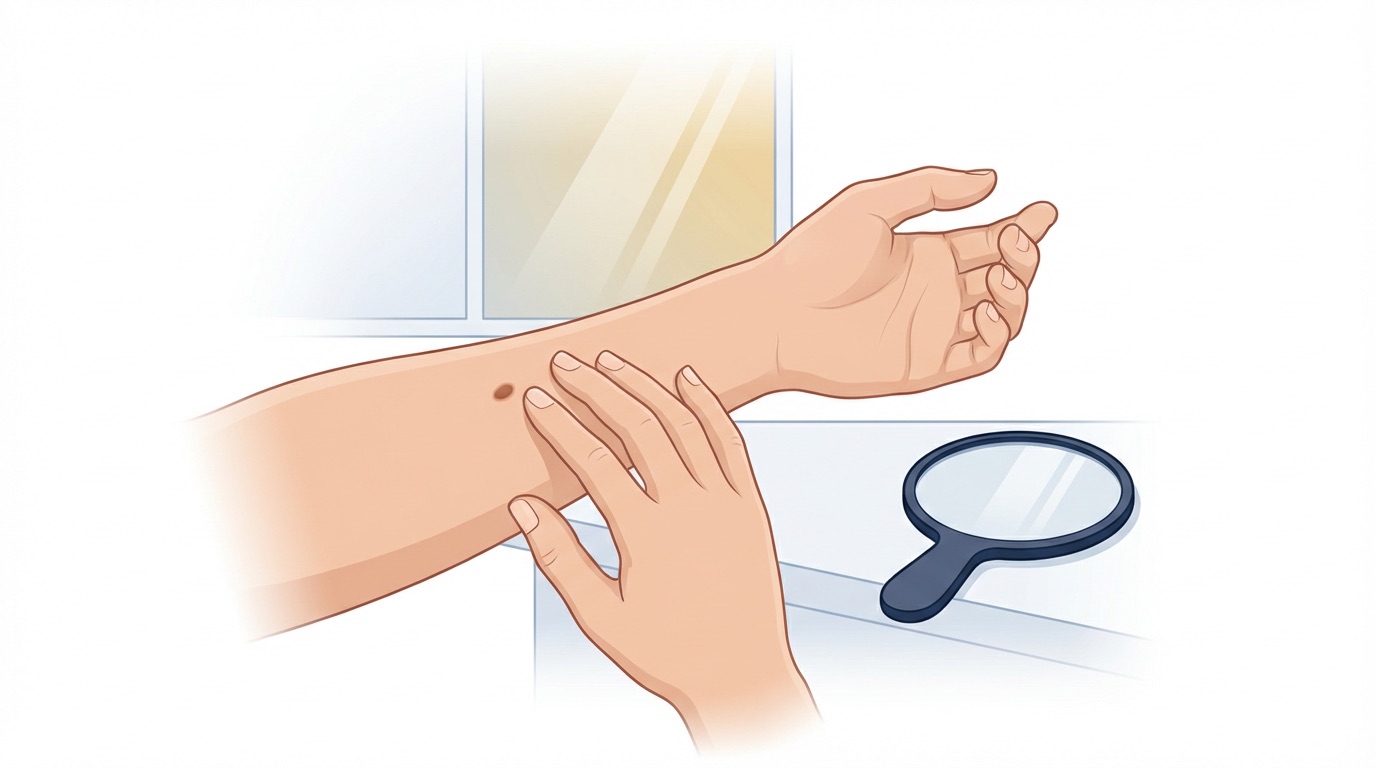
Memory is a poor witness to slow change; photographs are far more reliable. Once the post-holiday tan has faded, photograph any mole you are unsure about in good, even daylight, from a consistent distance, with a ruler or a coin beside it for scale. Repeat the photograph monthly under the same conditions and compare the images side by side. A monthly self-check of your whole skin — using a mirror, or a partner’s help, for your back and scalp — takes only a few minutes and makes a genuine change far easier to spot early.
What a specialist mole check involves
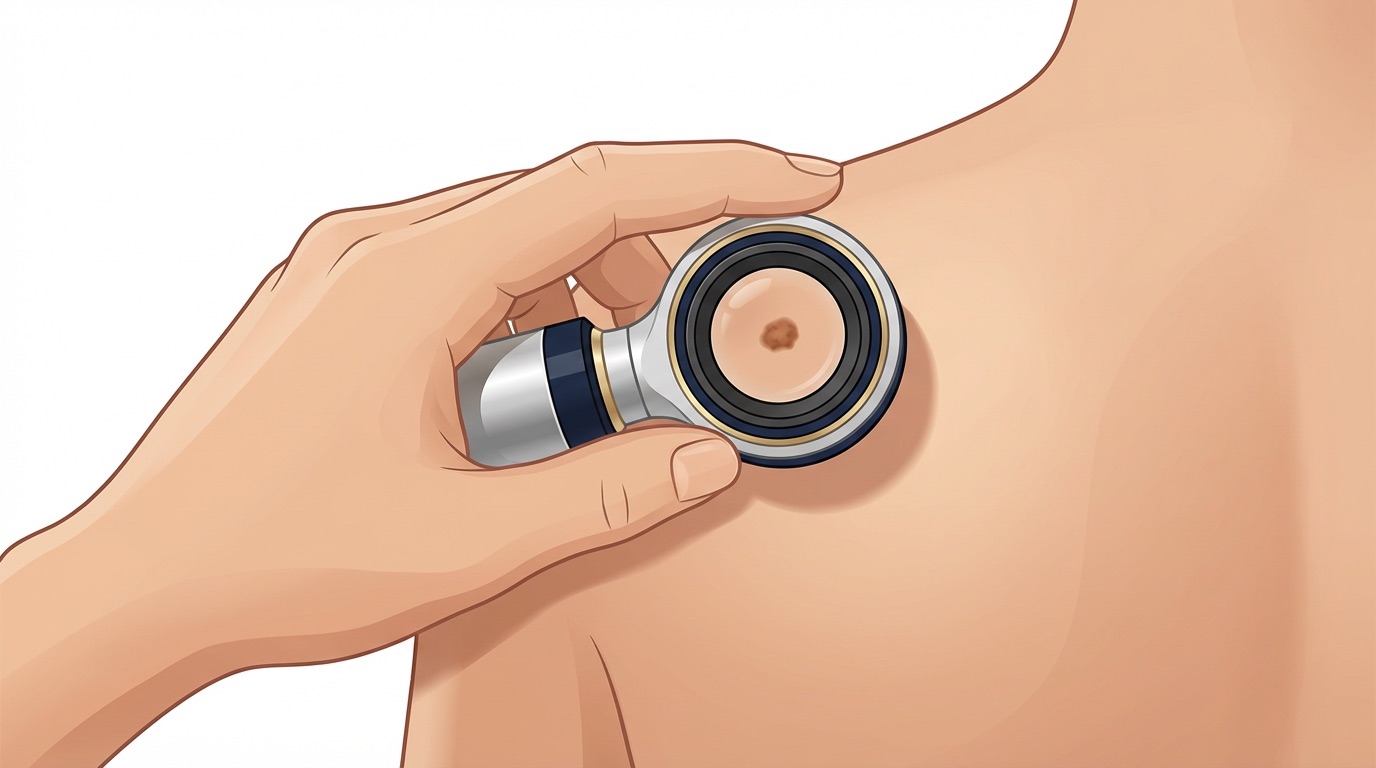
A specialist mole check is straightforward and painless. It involves a full-skin examination from scalp to soles — including the areas patients rarely see themselves — and dermoscopy, in which a handheld instrument with polarised light and magnification is used to examine the structures within a mole that are invisible to the naked eye. Dermoscopy allows many benign moles to be confidently diagnosed without any need for removal, and it helps identify the small number of lesions that genuinely warrant a biopsy or excision.
If you are concerned about a mole, your GP is a sensible first port of call, and the NHS operates an urgent skin cancer referral pathway for lesions with worrying features. A private specialist review is an alternative route that many patients choose for speed and reassurance, particularly when they would like a full head-to-toe skin examination at the same time. Both routes lead to the same careful assessment; what matters is that a changing mole is seen.
Conclusion
The mole you noticed after your holiday is, in all likelihood, harmless — most are, and always have been. But a mole that is genuinely new after forty, that is changing out of step with its neighbours, or that shows any of the features described above deserves a proper look, and checking is quick, painless and almost always ends in reassurance. If you would like an expert opinion, you can arrange a specialist mole and skin check with Mr Singh, and our guide to the ABCDE rule is a useful reference to keep for your monthly self-checks.
You can read more about melanoma and the other common skin cancers at our skin cancer centre. And for next summer, our sunscreen and SPF guide explains how to enjoy the sun while protecting the skin you have just spent a fortnight showing off.