Earlobe Reduction
Earlobe reduction is a precise, minor procedure designed to reduce the size of enlarged or elongated earlobes and restore a more youthful, proportionate shape. It is ideal for patients whose earlobes have become stretched through age, genetics or heavy earring wear.
Overview
Earlobe reduction is a small but rewarding procedure in which excess tissue is carefully removed from the lower part of the ear to reduce its overall size and restore a natural, proportionate shape. The earlobe is the only part of the ear not supported by cartilage, which means it is particularly prone to stretching and elongation over time.
Patients commonly request earlobe reduction when their earlobes appear disproportionately large compared to the rest of the ear, have become lax or pendulous with age, or have been gradually stretched by years of wearing heavy earrings. The procedure is performed under local anaesthetic and takes around 30–45 minutes, with most patients returning to their normal activities the following day.
Benefits
- More youthful appearance: Shorter, firmer earlobes help restore a more youthful profile around the lower face and jawline.
- Better proportion: The earlobe is brought back into balance with the rest of the ear and with the surrounding facial features.
- Symmetry correction: Differences in size or shape between the two earlobes can be addressed during the same procedure.
- Quick and minimally invasive: Performed under local anaesthetic with minimal downtime and a rapid return to daily activities.
- Hidden scars: Incisions are planned along natural contours to keep any resulting scar as discreet as possible.
- Renewed confidence: Many patients feel more comfortable wearing earrings or styles that draw attention to the ears.
Surgical Techniques
The approach is tailored to the size and shape of your earlobes and the outcome you wish to achieve. Mr Singh will plan and mark the incisions carefully at the start of the procedure, which is performed as a day case under local anaesthetic.
- Local anaesthetic: A small amount of local anaesthetic is used to numb each earlobe; you may feel a brief stinging sensation as the anaesthetic goes in, after which the procedure itself should be comfortable.
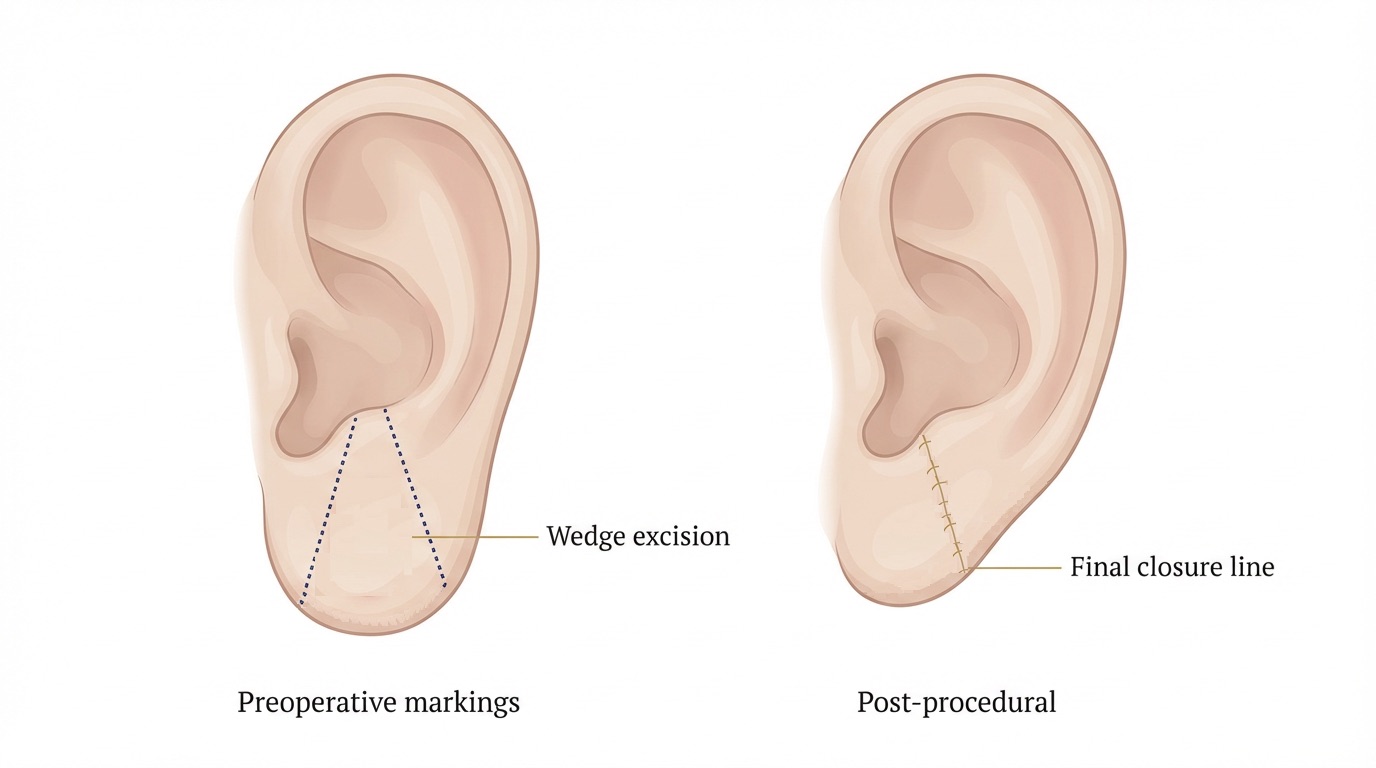
- Wedge or margin excision: A small wedge of skin and soft tissue is removed from the lower edge of the earlobe to reduce its height, or from the outer margin to reduce width.
- Careful contouring: The remaining tissue is shaped to recreate a natural, gently curved earlobe outline that flows smoothly into the rest of the ear.
- Fine suture closure: The edges are closed in layers using very fine sutures to give a precise, well-healed scar.
- Re-piercing: If desired, the earlobe can be re-pierced once fully healed, usually around 3 months after surgery.
Risks & Considerations
General Risks
- Infection: A small risk of wound infection that can delay healing and occasionally require antibiotics.
- Bleeding or bruising: Minor bleeding or bruising around the earlobe is common and usually settles within a week or two.
- Scarring: Permanent scars which usually fade well but cannot be made invisible.
- Local anaesthetic reaction: Very rare allergic or systemic reactions to local anaesthetic.
Specific Risks to Earlobe Reduction
- Asymmetry: Minor differences in size or shape between the two earlobes can persist despite careful planning.
- Notching or contour irregularity: A small step or irregularity along the earlobe margin can occasionally develop as the wound heals.
- Hypertrophic or keloid scarring: Earlobes can be prone to thickened or raised scars, particularly in patients with a personal or family history of keloids.
- Altered sensation: Temporary numbness around the earlobe is common and usually resolves within a few weeks.
- Recurrence of laxity: The earlobe may continue to show signs of age-related thinning or stretching over many years.
Recovery
Immediate Aftercare
- Mild discomfort: Any soreness is usually mild and well controlled with simple painkillers such as paracetamol.
- Swelling and bruising: Some swelling and bruising around the earlobe is normal and typically settles within 7–10 days.
Wound Care
- Dressings: A small dressing is applied which can usually be removed the following day. Gentle cleaning with mild soap and water is then encouraged.
- Avoiding traction: For the first 6 weeks, avoid pulling, rubbing or catching the earlobes on clothing, jewellery or hairbrushes until the wounds are fully healed.
- No earrings: Earrings should be avoided for at least 3 months to allow the tissues to heal fully before re-piercing.
Scar Advice
- Silicone gels: Silicone gels or sheets can be used once the wounds are healed to help optimise the final scar.
- Sun protection: Protect the scars from direct sun for the first 6–8 weeks to avoid pigmentation changes.
- Scar massage: Gentle scar massage once healed helps the scars soften and flatten.
Follow-Up
- Initial post-op visit: Typically scheduled 10–14 days after surgery for a wound check and to remove any non-absorbable sutures.
- Subsequent visits: Usually seen again at 6 weeks and then at around 3 months to review the final shape and scar.
- Long-term care: Mr Singh remains available for any concerns or further follow-up as required.
Procedure Summary
Ready to Discuss Earlobe Reduction?
If you are considering earlobe reduction, please feel free to contact us to answer any questions you may have or to schedule a consultation and learn more about how this procedure may benefit you.
Book a Consultation