After months of grey skies, the British summer tends to arrive all at once — a warm bank holiday, a garden lunch, a last-minute booking somewhere hot. If you have had surgery in the past year, though, one small area of skin deserves a moment's planning before you reach for the sun cream: your scar. Healing scars respond to sunlight quite differently from the skin around them, and a few simple habits over the summer months can make a genuine difference to how a scar looks for years to come.
Why scars need more care than the skin around them
It is tempting to assume that once a wound has closed, the skin has simply returned to normal. In reality, a scar is repair tissue rather than ordinary skin. The surface layer over a new scar is thinner, the collagen beneath it is still being reorganised, and the pigment cells that normally protect skin from ultraviolet (UV) light behave unpredictably within it. Some scars make too little pigment and remain pale; others overreact to UV and darken sharply. Either way, a scar does not carry the same natural defences as the skin on either side of it — which is why it needs a level of sun protection that the rest of your skin does not.
What the sun does to a healing scar
Three things tend to happen when a fresh scar meets strong sunlight. First, it burns more easily. With a thinner surface and little protective pigment, a scar can scorch in a fraction of the time the surrounding skin would take, and a sunburnt scar is both uncomfortable and a setback to healing.
Second, and most importantly, UV exposure can cause hyperpigmentation. Sunlight can stimulate the pigment cells in and around a healing scar to produce excess melanin, leaving the scar noticeably darker than the skin around it. Unlike an ordinary tan, this discolouration can be very slow to fade — and in some cases it is permanent. A scar that might otherwise have settled into a fine pale line can be left as a visible dark mark, entirely avoidably.
Third, sun exposure can prolong the redness of a young scar. Immature scars are pink because they are still richly supplied with blood vessels, and UV can keep that inflammatory phase going for longer, delaying the moment the scar finally begins to blend in.
The vulnerable window: twelve to eighteen months
A scar is considered immature for roughly twelve to eighteen months after surgery. During this period it is still remodelling — softening, flattening and gradually losing its pink colour — and it is at its most vulnerable to UV throughout. This is why the standard advice is to protect any exposed scar carefully for at least the first year, and ideally until it has fully matured to a pale, flat line. A scar from an operation last autumn is still very much a work in progress this summer, however healed it may look.
A simple summer scar routine
Protecting a scar is not complicated, and none of it needs to get in the way of enjoying the summer. The essentials are these:
- Wait until the wound is fully healed: sunscreen should only go on skin that is completely closed and dry, with no scabs or open areas. Until then, keep the area covered and out of the sun altogether.
- Cover first: shade, clothing and tape are the most reliable protection of all. A sleeve, a collar, a hat or a strip of micropore tape over the scar blocks UV far more dependably than any cream.
- SPF 30–50 on any exposed scar: once healed, apply a high-factor, broad-spectrum sunscreen to the scar whenever it will see the sun, for at least the first year.
- Reapply regularly: sunscreen wears off with time, sweat and swimming. Top it up through the day, just as you would for a child's skin.
- Silicone gel or sheets: silicone is the best-evidenced simple measure for keeping a scar flat, soft and pale, and it sits happily under sunscreen. Used consistently, it earns its place in any scar routine.
- Massage: once the wound is soundly healed, gentle daily massage with a bland moisturiser helps keep the scar supple as it remodels.
"I give every patient the same advice before their first summer with a new scar — treat it as a part of you that has not yet learnt to cope with the sun, because that is exactly what it is. Shade and cover first, a good sunscreen on top, silicone underneath. None of it is complicated, and it is the closest thing we have to a guarantee that a scar will fade as well as it possibly can."
Swimming, holidays and practical questions
The same questions come up in clinic every June. When can I swim? Once the wound is fully healed — closed, dry, with no scabbing — swimming in a pool or the sea is perfectly fine; before that point, the area should be kept dry and covered. Does salt water or chlorine harm a scar? Not once it is healed, though it is sensible to rinse and reapply sunscreen afterwards.
Holidays deserve a little extra thought. UV levels in southern Europe or further afield are considerably stronger than at home, so the routine matters more, not less: seek shade in the middle of the day, consider a rash vest or UV-protective clothing for scars on the trunk or shoulders, and pack both the sunscreen and the silicone. A strip of tape over a small scar is a perfectly good, low-fuss solution on the beach.
Do older scars still need protection?
Once a scar has matured — typically beyond eighteen months — it becomes far more resilient. A pale, flat, silvery scar is much less likely to darken in the sun than a pink one. Even so, scar tissue often remains slightly less pigmented than normal skin for life, and can still burn more readily. Sensible sun protection remains a good habit for any prominent scar during prolonged exposure, but the intensive routine belongs to that first year or so; after that, ordinary care is usually enough.
When a scar needs review
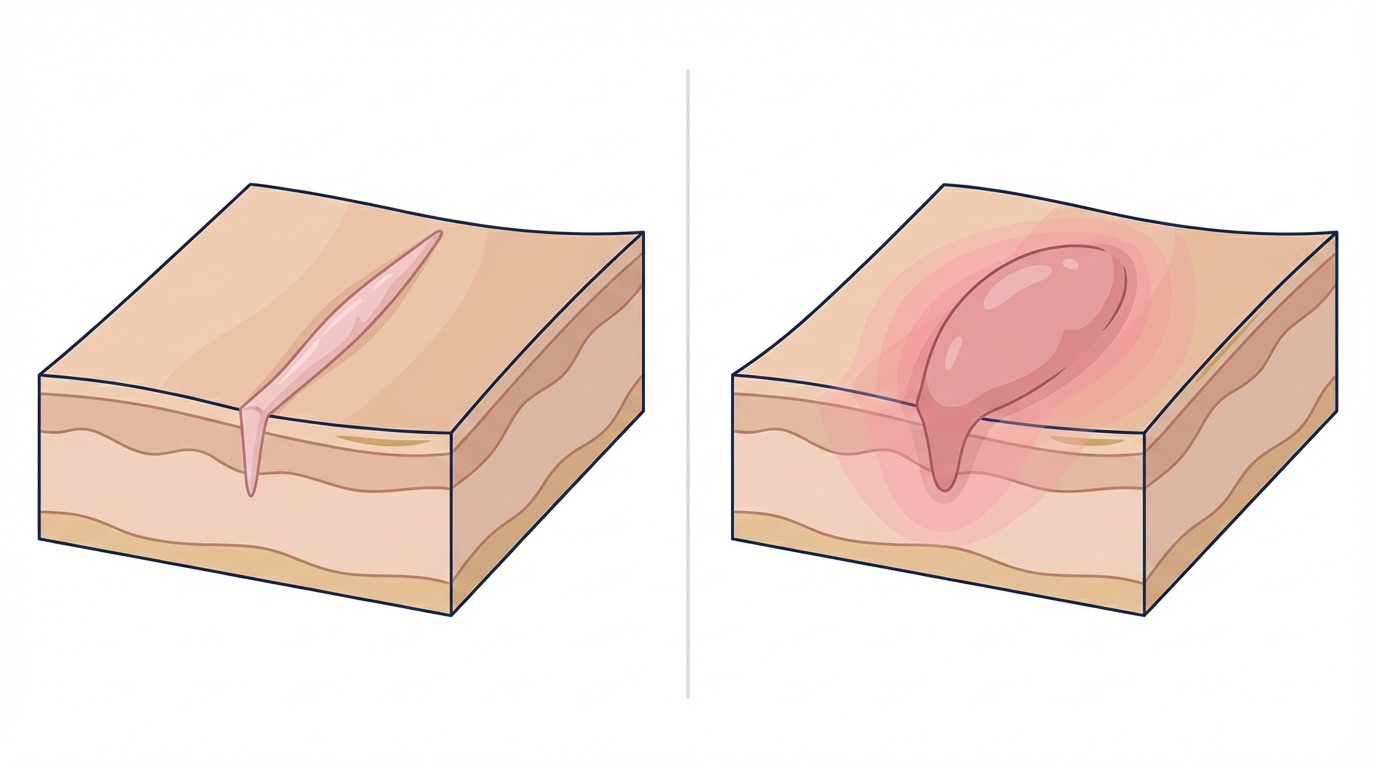
One reassurance worth stating plainly: sun exposure does not cause keloid scars. If a scar darkens after a sunny fortnight, that is pigmentation, not keloid change, and it is common. What does deserve attention is a scar that is becoming progressively raised, firm, itchy or tender, or one that is growing beyond the boundaries of the original wound. These are the features of hypertrophic and keloid scarring, and the honest message is that early treatment works better — a thickening scar reviewed within months is far easier to settle than one left for years. If your scar is behaving this way, whatever the season, it is worth having it assessed rather than waiting to see.
Conclusion
A scar is with you for life, but how you treat it in its first summer has a lasting say in how it looks. Keep it covered until healed, protect it with shade and SPF 30–50 for at least the first year, use silicone consistently, and it will have every chance of fading into a fine, quiet line. You can read more about the full range of options on our scar management page, including non-surgical scar treatments such as silicone therapy and steroid injection, and scar revision surgery for established scars that have not settled as hoped.
If your scar is raised or itchy rather than simply dark, our guide to keloid vs hypertrophic scars explains the difference and what can be done. And if you would like a scar of your own reviewed — new or old — Mr Singh sees patients for scar assessment throughout the year, sun cream optional.